Woodland Management at Llyn Parc Mawr
History of the site
LlPMCWG currently manages 24 hectares (approx.) of a 60-hectare block of forest, known as Llyn Parc Mawr. This woodland area was originally planted with a mixture of softwoods, predominantly Corsican pine in 1949. Now there is a wide range of species present of the site including both native and non-native trees and shrubs many that have been brought to the woodland by wind, animals, or humans. Wet areas are dominated by willow, birch, and alder, whereas in drier parts of the woodland you will find, pines, cedar and fir alongside beech and oak. The understorey consists of brambles and the invasive Himalayan cotoneaster (Cotoneaster simonsii) as well as 49 lichen and 25 byrophyte species recorded and numerous other rare plant species such as dune heleborine (Epipactis dunensis). Llyn Parc Mawr was the Welsh Commission’s project for European Year of the Environment in 1988 and subsequently, the lake with viewing hides, was opened in October 1988 by the Marquess of Anglesey.
Current
The present composition of the woodland by area is approximately 61% conifer (55% pine, 6% other conifer), 20% mixed broadleaves, 15% open areas and 4% wind-blow. It is used currently for recreation and watching wildlife by locals and tourists and was managed by Natural Resources Wales on behalf of the Welsh Government until LlPMCWG secured a management agreement in 2016.
Our Plans for the future
The area of woodland proposed to be under the management of Llyn Parc Mawr Community Woodland Group (LlPMCWG) will be managed for multiple objectives. The primary objectives are for recreation, health and well-being, biodiversity, small scale timber production to be used in the local economy and as a community education resource.
Over the next 25 years, the woodland will become more diverse in tree species through planting a range of native and European broadleaved tree species and non-native coniferous species. The approximate composition by area in 2040 will be 55% conifer (51% pine, 4% other conifer), 30% mixed broadleaves and 15% open areas. There will be a 10% increase of broadleaves: 3.8% hazel, 1.8% sweet chestnut, 1.5% oak, 1.4% beech and 1.5% other species. The majority of the area will be managed as high forest under continuous cover forestry management. There will be no clear-felling and replanting of areas greater than 0.25ha. The canopy will be retained as much as possible and will be under-planted with suitable species to form a more resilient canopy. There will be two areas of coppice established with small coupes, no more than 0.25ha, of 15 to 20-year rotational coppice. These areas will be enriched through the planting of sweet chestnut, sessile oak and hazel and will be managed as coppice with standards, the group also plans to have a small area of basket willow for small-scale craft projects.
Forest management Objectives
- Increase structural diversity,
- Increase number of tree storeys,
- Increase biological diversity,
- Increase tree species,
- Improve habitats for a wide range of species with special awareness for European protected species
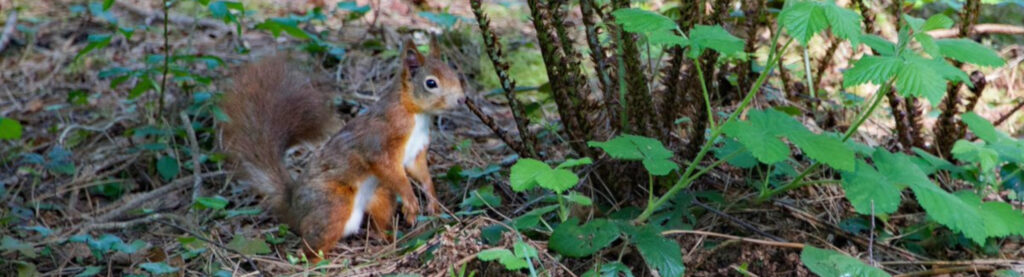
- Retain levels of pine in line with agreed percentages for red squirrel conservation
- Use opportunities to involve schools and community volunteers in planting,
- Small-scale non-commercial firewood production for community
- Small-scale timber production for projects within the wood
- Improve access for all abilities
- Retain recreation opportunities
- Improve canopy connectivity
- Develop as an educational resource